UNCERTAINTY IN LEADERSHIP
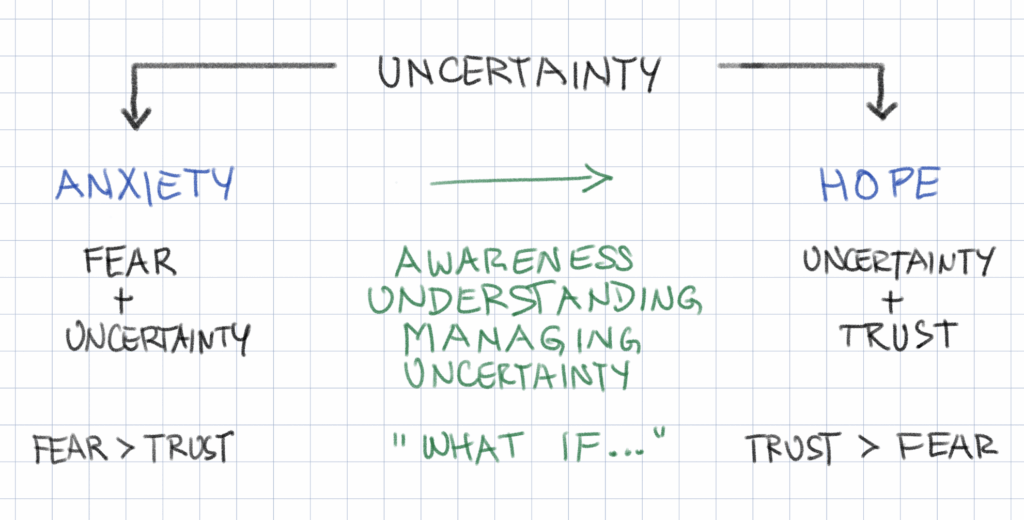
Uncertainty Model (Krieger, 2026)
You are successful. Yet internally, you quietly feel the pressure, responsibility and worry as you navigate the uncertainty that's part of leadership.
And it shapes how you lead and make decisions.
The Science
What stood out in my research is how innately connected our core beliefs, emotions and thoughts are, and how they influence our behaviours.
HOW EMOTIONS SHAPE YOUR DECISIONS:
Fear is our most primal emotion (it’s there to keep you alive), and when coupled with the uncertainty that is part of leadership, it becomes a powerful driver of how you make decisions.
‘Anxiety’ isn’t a very popular word in leadership, but it is part of it, and it shows up in both leadership explosion and implosion. You may experience it as feeling worried, a racing mind, or feeling on edge. Note: In this context, I don’t refer to anxiety in the sense of ‘anxiety disorder’, but the feeling of anxiety, the emotion that is innately human. Emotions are information, they tell us something is important.
Below is my uncertainty model, from anxiety to hope. Learning how to go from FEAR > TRUST to TRUST > FEAR is how you become a pressure-resilient leader.
anxiety = fear + uncertainty
hope = uncertainty + trust
Raising Hope = Pressure-Resilient Leadership
(because it helps you manage the uncertainty in adaptive ways through practicing pressure diffusion)