
Your core beliefs are subjective, deeply anchored cognitive constructs that provide a lens through which you view yourself, others and the world around you (Beck and Beck, 2020). Understanding core beliefs, and their development, is fundamental to understanding your emotions, thoughts and behaviours. Core beliefs can be positive, neutral or negative, and you can simultaneously hold beliefs in each orientation (ibid).
While formed predominantly during the early years of your life, core beliefs can also be shaped through significant and/or traumatic events in later years (Osmo et al., 2018, Taku et al., 2015). Positive and neutral beliefs are predominantly developed while you feel safe in your environment, and while this does not exclude negative events or experiences, the overall life perspective is oriented towards believing in your ability to cope with stressors (Beck and Beck, 2020). Negative core beliefs are more likely to form when you experience feedback or events making you feel physically or emotionally unsafe (ibid).
Negative Core Beliefs
Negative core beliefs can contribute to unhealthy/maladaptive emotions (Beck and Beck, 2020), destructive/maladaptive thoughts, and unhealthy behaviours (Lige, n.d.). As all core beliefs, they can be about yourself, others, or the world in general. For the purpose of this article, the focus will be on beliefs about self.
Different terms, often used interchangeably, are utilized to describe the construct of ‘negative core beliefs’ (e.g., Osmo et al., 2018; Otani et al., 2017). An alternate term used in academic and clinical contexts is ‘maladaptive core beliefs’ (e.g., Dingemans et al., 2006; Koerner et al., 2015), and in coaching and personal development, the term ‘shadow beliefs’ (e.g., Rose, n.d.; Yeazel, n.d.) is also utilized. The three terms have developed alongside each other, with ‘negative core belief’ being the most commonly appearing term in books (Google, 2026) (Figure 4). However, in the absence of a scientifically agreed upon definition, and variability in applied practice, the terms used vary in definition between synonyms and near-synonyms, which can cause confusion, especially to those experiencing and analyzing the beliefs.
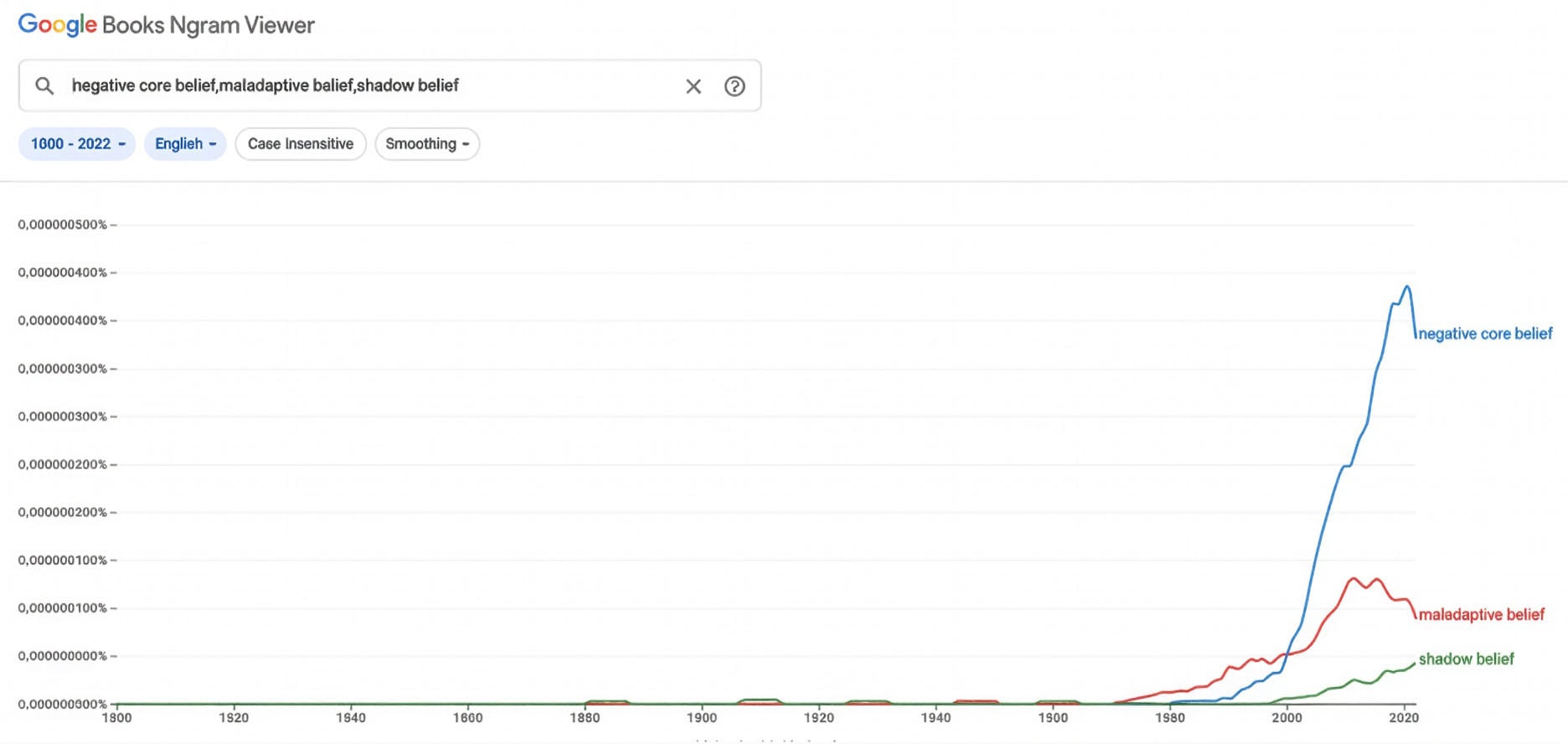
Figure 1. Graph of Google Books Ngram Viewer for frequency of terms ‘negative core belief’, ‘maladaptive belief’, ‘shadow belief’ occurring in over 5 million digitized books spanning from 1800 – 2022 (Google, 2026).
For this article, the terms ‘negative core beliefs’, ‘maladaptive core beliefs’ and ‘shadow beliefs’ are regarded as synonyms, sometimes simply referred to as ‘beliefs’, and are used interchangeably, particularly with the phrases ‘negative core beliefs’ and ‘maladaptive core beliefs’ common in academic literature. However, words matter, and the choice made for this article is not meant to diminish the importance of thoughtful and empathic phrase selection in practical application. The phrases ‘negative core beliefs’ and ‘maladaptive core beliefs’ can imply negativity or fault, whereas ‘shadow beliefs’ can advocate for change and hope, alluding to the potential for reframing, as a shadow cannot exist without light (Kube and Rauch, 2025; Odorisio, n.d.). While beyond the scope of this article, I am curious to explore the implications of these linguistic nuances in future research as there are no relevant studies available that I am aware of. Supporting significance of this exploration are studies that suggest improved outcomes for people when empathic language is used by psychotherapists and coaches (Diller et al., 2024; Elliott et al., 2018).
Beck and Beck (2020:32) categorize negative core beliefs about yourself in three categories: helplessness, unlovability and worthlessness. The Negative Core Beliefs Inventory further distinguishes between negative core beliefs about yourself and others (Osmo et al., 2018); however, caution should be exercised in this approach as beliefs about others are often projections of underlying unhealthy/maladaptive self-focused beliefs (Humphrey et al., 2021).
The following Table 1, using Beck & Beck’s classifications (Beck and Beck, 2020:32), offers examples that represent self-focused negative core beliefs from various literature with the highlighted beliefs being the overarching belief in the category and others being derivatives thereof.
Table 1. Negative Core Beliefs/Maladaptive Beliefs/Shadow Beliefs (Beck and Beck, 2020; Lige, 2025).
Helplessness |
Unlovability |
Worthlessness |
|
I am not good enough |
I am unlovable |
I don’t have value |
|
I am weak |
I am unwanted |
I am a mistake |
|
I am a loser |
I am ugly |
I am an embarrassment |
|
I am a failure |
I am unimportant |
I am an idiot |
|
I am a quitter |
I don’t belong |
I don’t deserve to live |
Reframing of Negative Core Beliefs
While negative core beliefs are anchored as your subjective truth, they may or may not be an objective truth (Beck and Beck, 2020). When you experience anxiety, negative core beliefs provide a cognitive layer contributing to not only real threat assessment but also to a biased view of perceived threats (Beck et al., 2005), which can lead to increased worry and rumination (Hirsch et al., 2015).
While these beliefs often seem inflexible, they can be reframed through active intervention (Ganz et al., 2022), allowing you to shift from destructive/maladaptive to adaptive beliefs, leading to more constructive/adaptive emotions, thoughts and behaviours (ibid).
Negative core beliefs can contribute to experiencing anxiety (LeDoux, 2015). While reframing negative core beliefs does not eliminate anxiety, it can positively impact your anxiety management, including reduced worrying about worrying/anxiety itself, reduced self-blame and anxiety avoidance behaviours, and increased self-trust (Clark and Beck, 2011; Koerner et al., 2015).
Although negative core beliefs can be reframed, it is important to recognize that this process is not meant to deny the feedback and events that led to them but rather acknowledge them to move forward (Clark and Beck, 2011; Lige, n.d.).
Reframing is possible when you perceive the process of reframing and the resulting positive belief to be more valuable than the negative core belief (Koerner et al., 2015). The question, ‘what is the payoff to holding on to the negative core belief?’ is fundamental to examining the patterns underlying the resistance to reframing shadow beliefs in some individuals. Potential answers to this question include expectation management: keeping expectations of performance low from yourself and others; certainty: the negative core belief feels more familiar than a new, unproven positive belief and feels part of an individual’s identity; avoidance of cognitive dissonance: avoiding tension with other beliefs that reframing may cause; and belonging: whereas reframing of shadow beliefs may lead to change in relationships due to set boundaries or not appearing as agreeable to others (Kube and Rauch, 2025).
The process of reframing is an emotional and cognitive process that involves identifying your shadow belief, challenging its validity, and restructuring it into a new, more adaptive belief (Beck and Beck, 2020; Lige, 2025). While this process may seem simple in theory, in practice it requires significant commitment, openness, vulnerability and courage as it represents your perceived reality that you assumed to be your truth for a long time, potentially most of your lifetime. Therefore, approaching the process with empathy is imperative (Beck and Beck, 2020; Lige, 2025).
Reframing negative core beliefs is a journey, not a single event. It requires continuous challenging of the shadow beliefs and asking the questions ‘Truth or lie?’, ‘Perception or reality?’ (Lige, n.d.). While an intervention such as therapy, coaching, or a workshop can help you reframe your negative core beliefs, it is to be acknowledged that these beliefs can and often will resurface, triggered by internal and external stimuli (Beck and Beck, 2020; Lige, n.d.). As your awareness of your shadow beliefs increases, and you practice the process of reframing, you increase your capacity for engaging in this process as part of your daily life (Goldin et al., 2013). When you experience anxiety, you may also experience an increased sense of agency through this process as it can allow you to take an active role in managing your anxiety instead of experiencing it passively (ibid).
As much as shadow beliefs can feel part of your identity, it is important to recognize that it is not what defines you as an individual. Foundational to your person’s identity and sense of self is your character (Peterson and Seligman, 2004).
References
Beck, A., Emery, G., Greenberg, R.L. (2005). Anxiety Disorders and Phobias: A Cognitive Perspective. Cambridge: Basic Books.
Beck, J.S., Beck, A.T. (2020). Cognitive Behavior Therapy: Third Edition: Basics and Beyond. New York: The Guildford Press.
Clark, D.A., Beck, A.T. (2011). Cognitive Therapy of Anxiety Disorders: Science and Practice. Guilford Press.
Diller, S.J., Mühlberger, C., Jonas, E. (2024). ‘The Empathy Factor: An Important Aspect of Success in Every Coaching Session.’ Consulting Psychology Journal, 76(3) pp. 225–237. https://doi.org/10.1037/cpb0000259
Dingemans, A.E., Spinhoven, Ph., van Furth, E.F. (2006). ‘Maladaptive Core Beliefs and Eating Disorder Symptoms.’ Eating Behaviors, 7(3) pp. 258–265. https://doi.org/10.1016/j.eatbeh.2005.09.007
Elliott, R., Bohart, A.C., Watson, J.C., Murphy, D. (2018). ‘Therapist Empathy and Client Outcome: An Updated Meta-Analysis.’ Psychotherapy, 55(4) pp. 399–410. https://doi.org/10.1037/pst0000175
Ganz, A.B., Rolnik, B., Chakraborty, M., Wilson, J., Tau, C., Sharp, M., Reber, D., Slavich, et. al. (2022). ‘Effects of an Immersive Psychosocial Training Program on Depression and Well-Being: A Randomized Clinical Trial.’ Journal of Psychiatric Research, 150 pp. 292–299. https://doi.org/10.1016/j.jpsychires.2022.02.034
Goldin, P.R., Ziv, M., Jazaieri, H., Hahn, K., Heimberg, R., Gross, J.J. (2013). ‘Impact of Cognitive Behavioral Therapy for Social Anxiety Disorder on the Neural Dynamics of Cognitive Reappraisal of Negative Self-beliefs: Randomized Clinical Trial.’ JAMA Psychiatry, 70(10) pp. 1048–1056. https://doi.org/10.1001/jamapsychiatry.2013.234
Google. (2026). Google Books Ngram Viewer. [Online] [Accessed on February 24, 2026] https://books.google.com/ngrams/graph?content=negative+core+belief,maladaptive+belief,shadow+belief&year_start=1800&year_end=2022&corpus=en&smoothing=3
Hirsch, C.R., Perman, G., Hayes, S., Eagleson, C., Mathews, A. (2015). ‘Delineating the Role of Negative Verbal Thinking in Promoting Worry, Perceived Threat, and Anxiety.’ Clinical Psychological Science, 3(4) pp. 637–647. https://doi.org/10.1177/2167702615577349
Humphrey, C., Bucci, S., Varese, F., Degnan, A., Berry, K. (2021). ‘Paranoia and Negative Schema about the Self and Others: A Systematic Review and Meta-Analysis.’ Clinical Psychology Review, 90:102081. https://doi.org/10.1016/j.cpr.2021.102081
Koerner, N., Tallon, K., Kusec, A. (2015). ‘Maladaptive Core Beliefs and their Relation to Generalized Anxiety Disorder.’ Cognitive Behaviour Therapy, 44(6) pp. 441–455. https://doi.org/10.1080/16506073.2015.1042989
Kube, T., Rauch, L. (2025). ‘“It’s Safer to Believe that Others Don’t Like Me” – A Qualitative Study on the Paradoxical Value of Negative Core Beliefs in Depression.’ Behaviour Research and Therapy, 184:104665. https://doi.org/10.1016/j.brat.2024.104665
LeDoux, J., (2015). Anxious: Using the Brain to Understand and Treat Fear and Anxiety. Penguin.
Lige, T. (2025). Connections Program Manual. Inside Out Leadership Development Group. Unpublished.
Lige, T. (n.d.). Being You – Lead Your Life from the Inside Out Coaching. Inside Out Leadership Development Group. Unpublished.
Odorisio, D. (2015). ‘Welcoming the Shadow as Guest and Self: Archetypal Approaches to Healing in Jung’s Red Book.’ Academia. https://www.academia.edu/12660178/Welcoming_the_Shadow_as_Guest_and_Self_Archetypal_Approaches_to_Healing_in_Jung_s_Red_Book
Osmo, F., Duran, V., Wenzel, A., Reis de Oliveira, I., Nepomuceno, S., Madeira, M., Menezes, I., (2018). ‘The Negative Core Beliefs Inventory: Development and Psychometric Properties.’ Journal of Cognitive Psychotherapy, 32(1) pp. 67–84. https://doi.org/10.1891/0889-8391.32.1.67
Otani, K., Suzuki, A., Matsumoto, Y., Shirata, T. (2017). ‘Relationship of Negative and Positive Core Beliefs about the Self with Dysfunctional Attitudes in Three Aspects of Life.’ Neuropsychiatric Disease and Treatment, 13 pp. 2585–2588. https://doi.org/10.2147/NDT.S150537
Peterson, C., Seligman, M.E.P. (2004). Character Strengths and Virtues: A Handbook and Classification. Cary: Oxford University Press.
Rose, S. (n.d.) Breakthrough Shadow Coaching Program. [Online] https://www.sharirosecoach.com/bsc
Taku, K., Cann, A., Tedeschi, R.G., Calhoun, L.G. (2015). ‘Core Beliefs Shaken By An Earthquake Correlate With Posttraumatic Growth.’ Psychological Trauma: Theory, Research, Practice, and Policy, 7(6) pp. 563–569. https://doi.org/10.1037/tra0000054
Yeazel, L. (n.d.) What’s A Shadow Belief?. [Online] https://www.lindayeazel.com/whats-a-shadow-belief