
what is anxiety
Often people shy away from talking about anxiety. I see it all the time when I start a conversation on the topic. But when I talk openly about it, and share my own feelings of anxiety, a shift happens. Instead of discomfort, courage shows up, followed by openness. To me, it’s a privilege to have these conversations as they are important conversations about a topic that’s uncomfortable, yet at the same time so inherently human.
One of the challenges I see in anxiety research is that much of it is focused on anxiety as a disorder, and that’s simply not the full picture. Therefore, I have written this article as an inquiry into viewing anxiety as part of who we are, not from a pure perspective of psychopathology. It is my hope to remove stigma around this topic and invite more open conversation around anxiety.
Feeling Anxiety
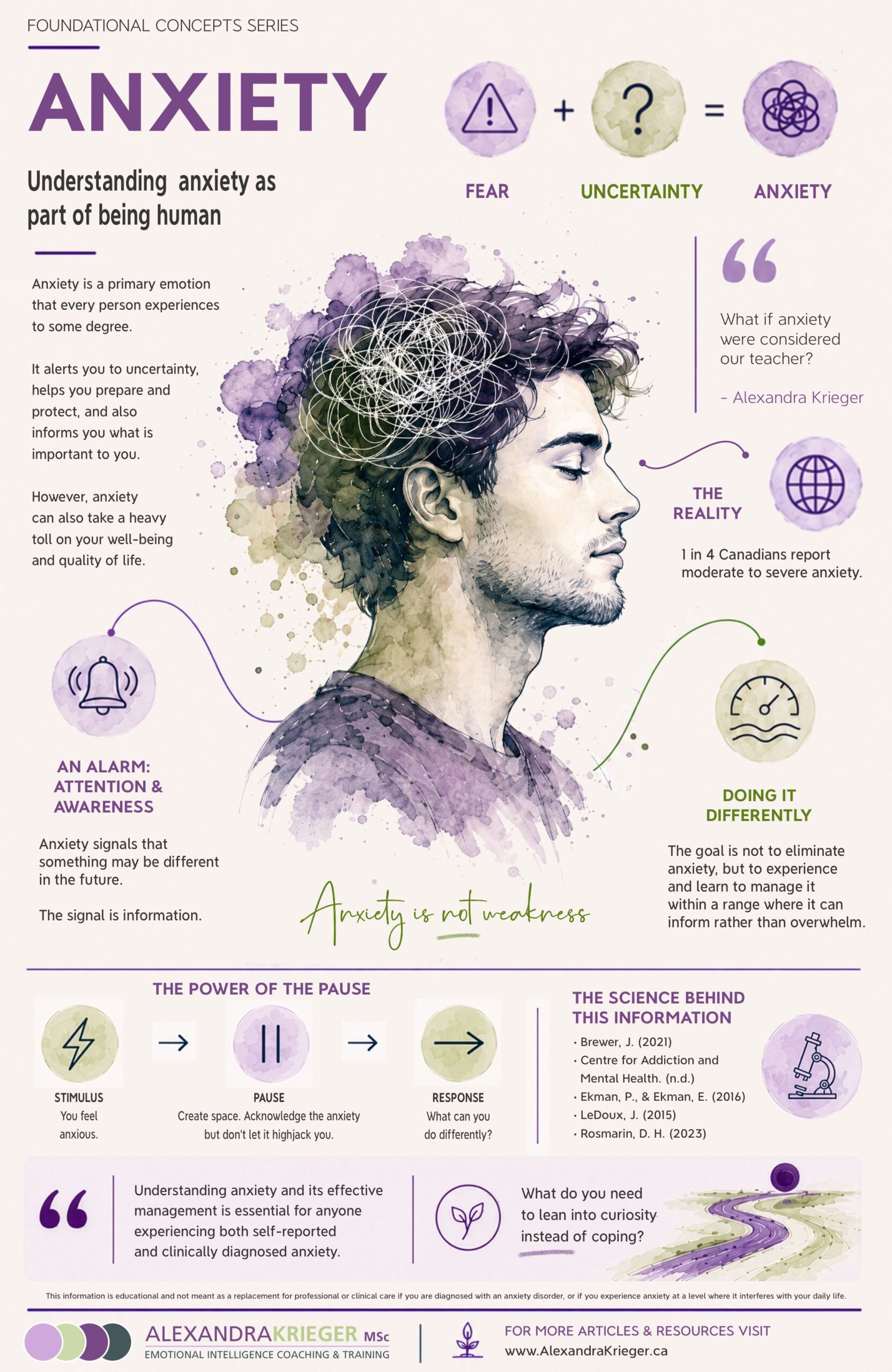
Anxiety is a primary emotion that every person experiences to some degree (Rosmarin, 2023). However, I often encounter people who tell me they do not experience anxiety. Through many curious conversations and research (Bateson et al., 2011; LeDoux, 2015; Rosmarin, 2023), I have learned that a reason for this is that the word ‘anxiety’ in everyday use is often misunderstood as ‘anxiety disorder’ which leads to confusion in language use. Furthermore, what I call anxiety, you may call worry, apprehension, nervousness or experience it as feeling on edge. The use of the word ‘anxiety’ in this article is inclusive of both self-reported and clinically diagnosed anxiety, unless specifically identified.
Anxiety is categorized as a variation of the emotion of fear (Ekman and Ekman, 2016). Fear is a rapid-onset emotion (Costa et al., 2014) that helps you react when you face a threat (LeDoux, 2015). However, fear differentiates from anxiety in that fear is typically caused by a specific threat, and with that the feeling of fear has a distinct start and finish, while when you feel anxiety, you may experience it as vaguer in cause and duration (ibid).
Dr. Judson Brewer (2021:46) describes anxiety in a simple equation that captures its essence:
‘Fear + uncertainty = anxiety’
Experiencing anxiety can be uncomfortable, and it is natural that you may want to avoid this discomfort (Zeidner and Matthews, 2018).
The statistics on anxiety are staggering:
- Global adult anxiety rates increased in recent years (Javaid et al., 2023).
- In Canadian surveys, 25.1% of respondents (about 1 in 4 Canadians) self-reported feeling ‘moderate to severe anxiety’ (Centre for Addiction and Mental Health, n.d.) while those with generalized anxiety disorder increased from 2.6% in 2012 to 5.2% in 2022 ( Government of Canada – Statistics Canada, 2023).
- This country-specific data reflects the global gap between self-reported anxiety and diagnosed anxiety disorders (Alonso et al., 2018, Krauss Whitbourne, 2020).
- Individuals with anxiety choosing not to seek help due to stigma (Alonso et al., 2018; Krauss Whitbourne, 2020), the ‘low rate of recognition’ (Kartal, 2011:online) of anxiety disorders through primary care physicians, and clinical diagnostic reliability challenges (Portman et al., 2011) may be contributing factors to this gap.
But there is more – and these are the statistics that keep me up at night. What’s even more staggering is that the ratio of self-reported anxiety disorders for women vs. men is almost 2:1 (Yeretzian et al., 2023). Some studies (Hallers-Haalboom et al., 2020:22; Remes et al., 2016) have concluded that this means that women are more prone to anxiety than men. Before you simply agree with this conclusion, read on because the data tells a different story: women are more likely to be open about anxiety and ask for help (Howard, 2016). Men in contrast are more likely to not speak up due to stigma around mental health (Chatmon, 2020) and instead make a choice to quietly self-medicate with alcohol, drugs or other unhealthy choices (Bolton et al., 2006).
Anxiety Research
Within anxiety research, there are two distinct perspectives, but scientists agree on the importance of acknowledging anxiety as this allows for acceptance, accountability and management of anxiety; as well as the recommendation of interventions through coaching, therapy, and possibly medication if you find yourself in a situation where anxiety interferes with your day-to-day life (Roemer et al., 2004, Rosmarin, 2023).
The first perspective focuses on the unhealthy/maladaptive nature of anxiety. Focusing on the significant toll anxiety takes on a person’s well-being, especially when experienced ongoing, the importance of effective treatments are reinforced (Roemer et al., 2004, Candilis and Pollack, 1997). Ongoing research has advanced how anxiety is viewed, which has led to the development of sub-categories in anxiety classifications in clinical contexts, and further attention to concurrent health challenges in connection to anxiety (Roemer et al., 2004; Wittchen et al., 2014). Distinguishing between general anxiety and sub-categories of anxiety validates a person’s struggle with their anxiety. Instead of minimizing or dismissing it as ‘it’s just anxiety’, which can contribute to stigma and judgements, ongoing research and education about living with and treating anxiety can not only improve individuals’ well-being but also create greater awareness of the impact of anxiety on mental health (American Psychiatric Association, n.d.; Bandelow et al., 2022).
The other perspective advocates for anxiety to not just be viewed as maladaptive, but for us to recognize it as being part of the human experience; an evolutionary defence mechanism (Horwitz and Wakefield, 2012, Rosmarin, 2023). This raises the question, ‘what if anxiety would be considered our teacher?’ Stepping into awareness and acceptance of anxiety from the perspective of curiosity allows you to explore what anxiety is trying to communicate (Rosmarin, 2023). This may feel uncomfortable, but when we understand that anxiety acts as an alarm, we learn that it signals that there is a possibility for something to be different in the future compared to the past or present (LeDoux, 2015). Inherently this alarm is neither positive nor negative, it is information – like any emotion. It is important to know that anxiety does not distinguish between an actual or a perceived threat, and while it is a forward-oriented emotion, it is interpreted through past experiences, events, thoughts and emotions, as well as your core beliefs (Javanbakht, 2023).
When bringing together both perspectives, it offers increased agency for those who struggle with anxiety through bringing together opportunities for support while at the same time building awareness, healthy capacity, and resilience towards experiencing anxiety.
The goal is not to eliminate anxiety, but rather to experience it in a range of intensity where it is helpful, not harmful, and to manage it in healthy ways.
State and Trait Anxiety
Let’s dive into the next layer of anxiety complexity.
State-trait anxiety theory proposes that there is another dimension to anxiety. This refers to a distinction between anxiety as a state, the emotion you feel when you experience anxiety, and anxiety as a trait, your long-term predisposition to anxiety (Cattell and Scheier, 1958; Spielberger et al., 1983). An emotion by definition is a transitory affective reaction to an internal or external stimulus (Ekman et al., 1984; Matsumoto and Hwang, 2012), which means there is a trigger that causes you to start feeling an emotion which will eventually also subside again. This is in contrast to your predisposition, your traits, which are anchored in your temperament, which are dynamic patterns of your personality (Berens, 2010), with research suggesting that ‘both genetic and environmental factors contribute to stability and change in personality traits’ (Bleidorn et al., 2021).
This complex relationship between nature (genetic) and nurture (environmental, the physical and social environment you were in during your formative years) in personality development must be considered (Keltikangas-Järvinen and Jokela, 2010) as trait anxiety research recognizes both your biological as well as your developmental factors contributing to anxiety vulnerability (Chen et al., 2019; Keltikangas-Järvinen and Jokela, 2010).
One More Layer: Your Core Beliefs
Both trait development, and the formation of core beliefs, the lens through which you see yourself, others and the world around you, share the developmental roots during the early, formative years of your life (Hayes and Hofmann, 2018; Keltikangas-Järvinen and Jokela, 2010).
Even though these two constructs have largely been separate areas in research, several studies explore them together, with findings suggesting a connection between personality traits and core beliefs, in particular the association of pathologically relevant traits with negative core beliefs/shadow beliefs (Hopwood et al., 2013; Muris, 2006; Samar et al., 2013). These insights provide further perspective on the development of trait anxiety through the lens of your personality and core beliefs as well as its influence on state anxiety as your core beliefs are closely linked to your emotions, thoughts, and behaviours (Beck et al., 2005).
Why It’s Important
Understanding anxiety and its effective management is essential for anyone experiencing anxiety, both self-reported and clinically diagnosed anxiety. Unhealthy/maladaptive self-coping strategies such as alcohol or unprescribed drug consumption are common among individuals with anxiety (Krauss Whitbourne, 2020). Learning emotional self-regulation through emotional intelligence is therefore critical (Zeidner and Matthews, 2010).
This article is educational and not meant as a replacement for professional or clinical care if you are diagnosed with an anxiety disorder, or if you experience anxiety at a level where it interferes with your daily life.
References
Alonso, J., Liu, Z., Evans-Lacko, S., Sadikova, E., Sampson, N., Chatterji, S., Abdulmalik, J., Aguilar-Gaxiola, S. et al. (2018). ‘Treatment Gap for Anxiety Disorders is Global: Results Of The World Mental Health Surveys In 21 Countries.’ Depress Anxiety, 35 pp. 195–208. https://doi.org/10.1002/da.22711
American Psychiatric Association (n.d.). DSM-5-TR. [Online] https://www.psychiatry.org/psychiatrists/practice/dsm
Bandelow, B., Werner, A.M., Kopp, I., Rudolf, S., Wiltink, J., Beutel, M.E. (2022). ‘The German Guidelines for the Treatment of Anxiety Disorders: First Revision.’ European Archives of Psychiatry and Clinical Neuroscience, 272 pp. 571–582. https://doi.org/10.1007/s00406-021-01324-1
Beck, A., Emery, G., Greenberg, R.L. (2005). Anxiety Disorders and Phobias: A Cognitive Perspective. Cambridge: Basic Books.
Berens, L.V. (2010). Understanding Yourself and Others: An Introduction to the 4 Temperaments-4.0. West Hollywood: Radiance House.
Bleidorn, W., Hopwood, C.J., Back, M.D., Denissen, J.J.A., Hennecke, M., Hill, P.L., Jokela, M., Kandler, C. et al. (2021). ‘Personality Trait Stability and Change.’ Personality Science, 2(1) e6009. https://doi.org/10.5964/ps.6009
Bolton, J., Cox, B., Clara, I., Sareen, J. (2006). ‘Use of Alcohol and Drugs to Self-Medicate Anxiety Disorders in a Nationally Representative Sample.’ The Journal of Nervous and Mental Disease, 194(11) pp. 818–825. https://doi.org/10.1097/01.nmd.0000244481.63148.98
Brewer, J. (2021). Unwinding Anxiety: New Science Shows How to Break the Cycles of Worry and Fear to Heal Your Mind. Avery.
Candilis, P.J., Pollack, M.H. (1997). ‘The Hidden Costs of Untreated Anxiety Disorders.’ Harvard Review of Psychiatry, 5(1) pp. 40–42. https://doi.org/10.3109/10673229709034724
Cattell, R.B., Scheier, I.H. (1958). ‘The Nature of Anxiety: A Review of Thirteen Multivariate Analyses Comprising 814 Variables.’ Psychological Reports, 4(3) pp. 351–388. https://doi.org/10.2466/pr0.1958.4.3.351
Centre for Addiction and Mental Health. (n.d.). Anxiety, Feelings of Depression and Loneliness Among Canadians Spikes to Highest Levels Since Spring 2020. [Online] https://www.camh.ca/en/camh-news-and-stories/anxiety-depression-loneliness-among-canadians-spikes-to-highest-levels
Chatmon, B.N. (2020). ‘Males and Mental Health Stigma.’ American Journal of Men’s Health, 14(4). https://doi.org/10.1177/1557988320949322
Chen, C., Ashari, A., Ibrahim, R., Sulaiman, W., Koo, K. (2019). ‘A Preliminary Study of Biological Attributed Risk Factor for Anxiety Among Anxious Children.’ International Journal of Education, Psychology and Counseling, 4(33) pp. 209–222. https://gaexcellence.com/ijepc/article/view/3128
Costa, T., Cauda, F., Crini, M., Tatu, M.-K., Celeghin, A., De Gelder, B., Tamietto, M. (2014). ‘Temporal and Spatial Neural Dynamics in the Perception of Basic Emotions from Complex Scenes.’ Social Cognitive and Affective Neuroscience, 9(11) pp. 1690–1703. https://doi.org/10.1093/scan/nst164
Ekman, P. (1984). ‘Expression and the Nature of Emotion.’ In: Scherer, K. and Ekman, P. (eds.) Approaches To Emotion. Psychology Press, pp. 319–343.
Ekman, P., Ekman, E. (2016). The Ekmans’ Atlas of Emotions. [Online] [Accessed on May 13, 2025] http://atlasofemotions.org/
Government of Canada – Statistics Canada (2023). Study: Mental disorders and access to mental health care. [Online] https://www150.statcan.gc.ca/n1/daily-quotidien/230922/dq230922b-eng.htm
Hallers-Haalboom, E.T., Maas, J., Kunst, L.E., Bekker, M.H.J. (2020). ‘The Role of Sex and Gender in Anxiety Disorders: Being Scared “Like a Girl”?.’ In: Lanzenberger, R., Kranz, G.S., Savic, I. (eds.) Handbook of Clinical Neurology, Sex Differences in Neurology and Psychiatry. Elsevier, pp. 359–368. https://doi.org/10.1016/B978-0-444-64123-6.00024-2
Hayes, S.C., Hofmann, S.G. (2018). Process-Based CBT: The Science and Core Clinical Competencies of Cognitive Behavioral Therapy. New Harbinger Publications.
Hopwood, C.J., Schade, N., Krueger, R.F., Wright, A.G.C., Markon, K.E. (2013). ‘Connecting DSM-5 Personality Traits and Pathological Beliefs: Toward a Unifying Model.’ Journal of Psychopathology and Behavioral Assessment, 35 pp. 162–172. https://doi.org/10.1007/s10862-012-9332-3
Horwitz, A.V., Wakefield, J.C. (2012). All we Have to Fear: Psychiatry’s Transformation of Natural Anxieties into Mental Disorders. New York: Oxford University Press.
Howard, J. (2016). Why Women are Way More Likely Than Men to Suffer Anxiety. CNN. [Online] [Accessed on February 26, 2025] https://www.cnn.com/2016/06/08/health/women-anxiety-disorders/index.html
Javaid, S.F., Hashim, I.J., Hashim, M.J., Stip, E., Samad, M.A., Ahbabi, A.A. (2023). ‘Epidemiology of Anxiety Disorders: Global Burden and Sociodemographic Associations.’ Middle East Current Psychiatry, 30:44. https://doi.org/10.1186/s43045-023-00315-3
Javanbakht, A. (2023). Afraid: Understanding the Purpose of Fear and Harnessing the Power of Anxiety. Rowman & Littlefield.
Kartal, M. (2011). ‘Challenges and Opportunities in Diagnosis and Management of Generalized Anxiety Disorder in Primary Care.’ In: Szirmai, Á. (ed.) Anxiety and Related Disorders. IntechOpen.
Keltikangas-Järvinen, L., Jokela, M. (2010). ‘Nature and Nurture in Personality.’ Focus, 8(2) pp. 180–186 https://www.psychiatryonline.org/doi/10.1176/foc.8.2.foc180
Krauss Whitbourne, S. (2020). Why Do People with Anxiety Disorders Avoid Getting Therapy? Psychology Today. [Online] https://www.psychologytoday.com/us/blog/fulfillment-any-age/202002/why-do-people-anxiety-disorders-avoid-getting-therapy
LeDoux, J. (2015). Anxious: Using the Brain to Understand and Treat Fear and Anxiety. Penguin.
Matsumoto, D., Hwang, H.S. (2012). ‘Culture and Emotion: The Integration of Biological and Cultural Contributions.’ Journal of Cross-Cultural Psychology, 43(1) pp. 91–118. https://doi.org/10.1177/0022022111420147
Muris, P. (2006). ‘Maladaptive Schemas in Non-Clinical Adolescents: Relations to Perceived Parental Rearing Behaviours, Big Five Personality Factors and Psychopathological Symptoms.’ Clinical Psychology & Psychotherapy, 13(6) pp. 405–413. https://doi.org/10.1002/cpp.506
Portman, M.E., Starcevic, V., Beck, A.T. (2011). ‘Challenges in Assessment and Diagnosis of Generalized Anxiety Disorder.’ Psychiatric Annals, 41(2) pp. 79–85. https://doi.org/10.3928/00485713-20110203-06
Remes, O., Brayne, C., van der Linde, R., Lafortune, L. (2016). ‘A Systematic Review Of Reviews on the Prevalence of Anxiety Disorders in Adult Populations.’ Brain and Behavior 6(7) e00497. https://doi.org/10.1002/brb3.497
Roemer, L., Orsillo, S.M., Barlow, D.H. (2004). ‘Generalized Anxiety Disorder.’ In: Barlow, D.H. (ed.) Anxiety and Its Disorders: Second Edition: The Nature and Treatment of Anxiety and Panic. Guilford Press, pp. 477–515.
Rosmarin, D.H. (2023). Thriving with Anxiety: 9 Tools to Make Your Anxiety Work for You. Nashville: Harper Horizon.
Samar, S.M., Walton, K.E., McDermut, W. (2013). ‘Personality Traits Predict Irrational Beliefs.’ Journal of Rational-Emotive & Cognitive-Behavior Therapy, 31 pp. 231–242. https://doi.org/10.1007/s10942-013-0172-1
Spielberger, C.D., Gorsuch, R., Lushene, R.E., Vagg, P., Jacobs, G.A. (1983). Manual for the State-Trait Anxiety Inventory (Form Y1 – Y2). Consulting Psychologists Press.
Wittchen, H.-U., Heinig, I., Beesdo-Baum, K. (2014). ‘Anxiety disorders in DSM-5: an Overview on Changes in Structure and Content.’ Nervenarzt, 85 pp. 548–552. https://doi.org/10.1007/s00115-013-3986-2
Yeretzian, S.T., Sahakyan, Y., Kozloff, N., Abrahamyan, L. (2023). ‘Sex Differences in the Prevalence and Factors Associated with Anxiety Disorders in Canada: A Population-Based Study.’ Journal of Psychiatric Research, 164 pp. 125–132. https://doi.org/10.1016/j.jpsychires.2023.06.018
Zeidner, M., Matthews, G. (2010). Anxiety 101. Springer Publishing Company.
Zeidner, M., Matthews, G. (2018). ‘Emotional Intelligence: A Brief Historical Introduction.’ In: Lorraine, L., Qualter, P. (eds.) An Introduction to Emotional Intelligence. John Wiley & Sons, pp. 1–17. https://doi.org/10.1002/9781394260157.ch1