
what is emotional intelligence (EQ)
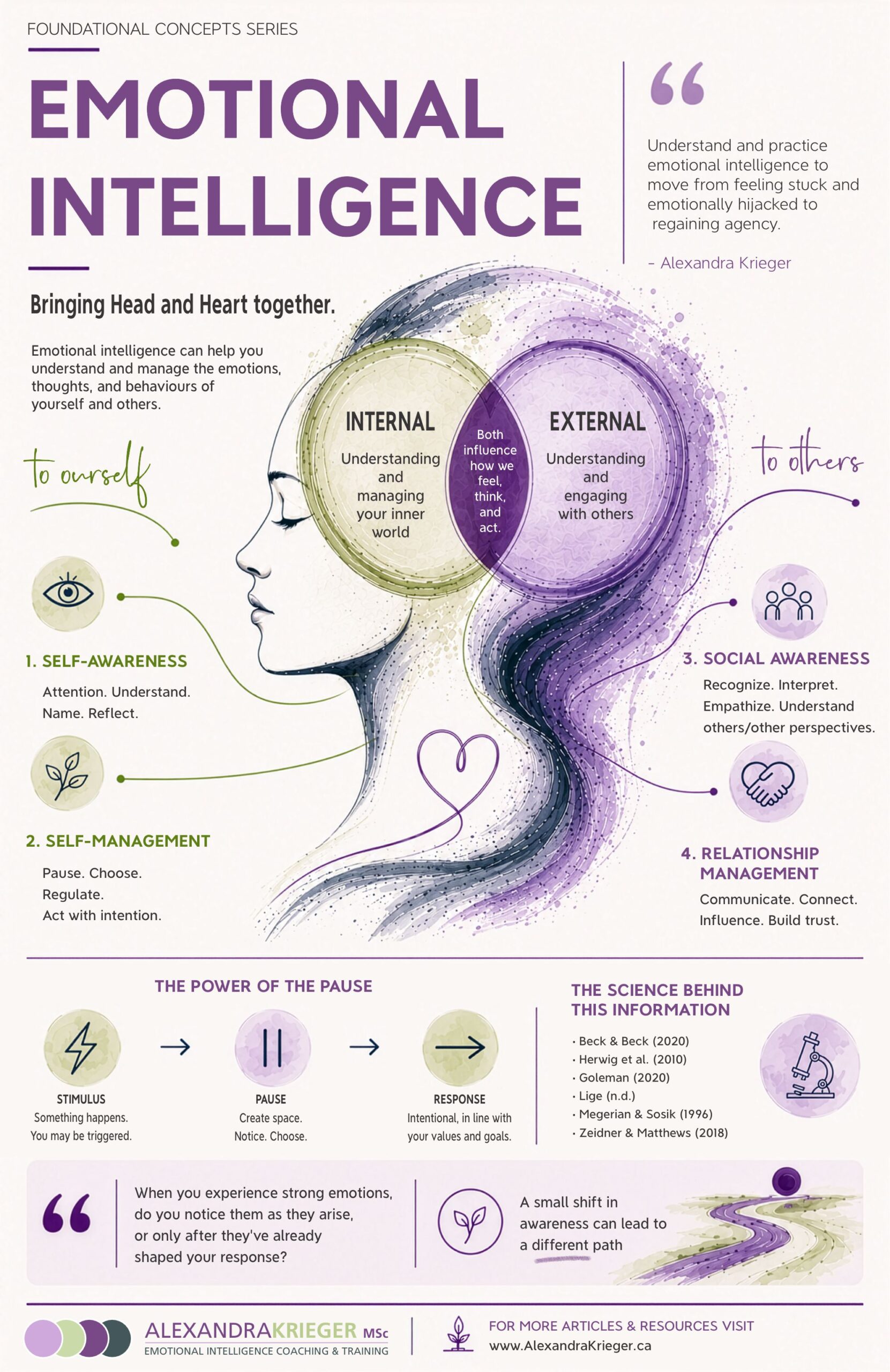
Emotional intelligence can support your ability to understand and manage emotions, beliefs, thoughts, and behaviours of yourself and others (Zeidner and Matthews, 2018). The phrase ‘emotional intelligence’ brings together heart (emotion) and head (intelligence) not only linguistically but also conceptually.
Emotional intelligence matters when it is practiced, but there is value in understanding it as well; I hope this article will provide you with the theoretical foundations to help you live and lead with emotional intelligence.
Emotional Intelligence Theory
Emotional intelligence theory distinguishes between three models. The trait model views emotional intelligence from the perspective of personality traits and how they relate to emotional functioning (Zeidner and Matthews, 2018). The ability model defines it as a person’s ability of ‘identifying emotions, assimilating emotions into thought, understanding emotions, and managing the emotions of oneself and others’ (Zeidner and Matthews, 2018). The third model takes a mixed model approach, blending cognitive abilities with personality traits (Goleman, 2020). Debating these models far exceeds the scope of this article – there have been countless books and research articles written for each side of the debate, however this overview highlights the importance of research in this field, inviting the ongoing discussion on how to operationalize emotional intelligence (Zadorozhny et al., 2024). While the research in the field of emotional intelligence is important and supports our understanding of emotions, it is equally important to remember that behind the data are people who are feeling emotions at a high level of complexity (Ledoux, 1998; Megerian and Sosik, 1996).
Through the four domains defining emotional intelligence, ‘Self-Awareness, Self-Management, Social Awareness, and Relationship Management’ (Zeidner and Matthews, 2018), you can increase awareness of anxiety, of the internal and external triggers related to your emotions, core beliefs, and thoughts, and learn to create healthier responses by influencing your inward and outward focused behaviours (Lige, n.d., Beck and Beck, 2020).
Worrying is defined by psychologist Daniel Goleman as ‘the heart of all anxiety’ (2020:58) and ‘emotional hijacking’ (ibid). Understanding and practicing emotional intelligence can allow you to move from feeling stuck and emotionally hijacked to regaining agency (Zeidner and Matthews, 2010).
It’s important to recognize that emotional intelligence has both a light and a dark side. You can utilize it to empower and create positive change, or it you be use it to manipulate in self-serving and harmful ways, both towards yourself and others (Davis and Nichols, 2016). For the purpose of this article, which is focused on personal growth, the emphasis will be on the light side/adaptive side of emotional intelligence.
Self-Awareness
While all domains of emotional intelligence hold important competencies (Goleman, 2020), self-awareness, the ability for you to observe your own emotions, thoughts, and behaviours, is foundational for creating personal change (Lige, n.d.). Neurological research shows that self-awareness of emotions alone ‘is capable of attenuating emotional arousal related brain activation’ (Herwig et al., 2010:17), which can help you shift from emotional reactiveness to reflective and introspective mindfulness during a stimulus event when you are being triggered (Herwig et al., 2010). The capacity for self-awareness, which is also called the ‘observing self’ (Lige, n.d.) allows you to metacognitively observe your own thoughts, emotions, and behaviours (Grant, 2001).
The theory of self-awareness describes it as being objective mindfulness, ‘the awareness that emerges through paying attention on purpose, in the present moment, and nonjudgmentally’ (Kabat-Zinn, 2003). However, it’s important to acknowledge that your lived experience is not textbook perfection – reality is ‘life is messy’. Your core beliefs and past experiences create biases, which are subjective preferences that influence how self-awareness is experienced (Beck and Beck, 2020; Treleaven, 2018). In addition, you will experience situational internal and external triggers that challenge your ability to step into your observing self instead of being emotionally hijacked (Goleman, 2020). The choice becomes to observe yourself through a lens of self-judgement, self-criticism and self-sabotage, or to explore self-awareness through the lens of self-empathy, self-respect and self-trust (Jack and Aithal, 2025; Sandua, 2024). The lens you choose can greatly influence your other domains of emotional intelligence, beginning with self-management.
Self-Management
With self-awareness comes a choice: you can passively experience your thoughts and emotions and behave reactively, or you can actively manage them and utilize them to influence your behaviours in desired ways (Fteiha and Awwad, 2020; Lu et al., 2022). Passive coping is marked by avoidance behaviour, emotional detachment, and blame of yourself and others (Fteiha and Awwad, 2020; Lu et al., 2022). Alternatively, stepping into active self-management of your thoughts and emotions is driven by curiosity, acceptance, positive self-feedback, and if needed, searching for external resources (Fteiha and Awwad, 2020; Lu et al., 2022).
One of the unique abilities we have as humans is the aptitude for pausing between stimulus and response, though aptitude does not always mean perfect practice. Creating the space to pause is a powerful theoretical concept in operationalizing emotional intelligence, however there can be contributing factors (again, life isn’t textbook perfection) that can lead to emotional hijacking to occur, leaving no gap between stimulus and response (Goleman, 2020). Also referred to as amygdala hijack, it happens rapidly. It’s a fight or flight response to a stimulus that happens without conscious initiation, with no space for the pause to occur (Orji, 2024). Studies suggest that there are several potential contributing factors to an amygdala hijack occurring that may include individual differences/personality traits, high stress levels – both chronic or situational, past traumatic experiences, past fear conditioning, cognitive biases, mental or physical health challenges, social factors, or low emotion regulation skills (ibid).
Learning to harness that space between stimulus and response to create the desired pause takes self-empathy and practice, but when successful, increases your capacity to make desirable choices of how to respond, both to self and others (Landry, 2019).
When you experience worry or anxiety, the power of the pause holds an even deeper meaning. Anxiety can be experienced as a perceived loss of control (Brewer, 2021), and the pause equals a sense of control, which can contribute to diminishing your anxiety levels both in internal and external oriented anxiety, including anxiety experienced in social interactions.
Social Awareness
A significant part of your life involves external stimuli/triggers and interactions. Social awareness allows you to observe and reflect on your external influences expressed through others’ emotions as well as their verbal and non-verbal behaviours (Salovey et al., 2003). Being able to accurately recognize and understand the emotions in others depends on your ability to not only be aware of, but also appropriately interpret another person’s verbal and non-verbal communication (ibid). Increasing this ability leads to increased empathy, one of the cornerstones of social awareness (ibid).
Empathy is a social competency that can further be broken into three sub-competencies: cognitive empathy, emotional empathy and compassionate empathy (Ekman, 2007). Cognitive empathy is the ability to intellectually understand how another person is feeling, while emotional empathy is the ability to share the feelings that another person is feeling (ibid). Compassionate empathy is the desire and choice to take action in support of how someone else is feeling (ibid).
Relationship Management
Human interaction is relationship management, the interaction between yourself and others (Luft, 1969). The gift and the challenge both lie in this human interaction not being controlled by one person, but by all involved in the relationship, be it personal or professional. At its best, it involves clarity, vulnerability, honesty and openness, authenticity, love and compassion. When this is mutual, it can increase trust, strengthening the relationship (Lige, 2025). On the flipside, when it is rooted in blame, conflict, manipulation and deception, even just by one person in the relationship, it can lead to lack of trust, thus weakening, or even ending the relationship (ibid).
For some people, interactions with others come naturally, while for others they take deliberate intention (Walker, 2020). The interplay between your personality including the dimension of introversion/extraversion, societal expectations and cultural norms all contribute to this while simultaneously adding complexity to your interactions and relationship management (ibid).
Emotional intelligence does not happen in isolation. While awareness and management of yourself are foundational, awareness of those you interact with, and relationship with others is part of the human experience.
References
Beck, J.S., Beck, A.T. (2020). Cognitive Behavior Therapy: Third Edition: Basics and Beyond. New York: The Guildford Press.
Brewer, J. (2021). Unwinding Anxiety: New Science Shows How to Break the Cycles of Worry and Fear to Heal Your Mind. Avery.
Davis, S.K., Nichols, R. (2016). ‘Does Emotional Intelligence have a “Dark” Side? A Review of the Literature.’ Frontiers in Psychology, 7:1316. https://doi.org/10.3389/fpsyg.2016.01316
Ekman, P. (2007). Emotions Revealed: Recognizing Faces and Feelings to Improve Communication, 2nd ed., New York: Holt Paperbacks.
Fteiha, M., Awwad, N. (2020). ‘Emotional Intelligence and its Relationship with Stress Coping Style.’ Health Psychology Open, 7(2):2055102920970416. https://doi.org/10.1177/2055102920970416
Goleman, D. (2020). Emotional Intelligence: Why It Can Matter More Than IQ. Bantam Books.
Grant, A.M. (2001). ‘Rethinking Psychological Mindedness: Metacognition, Self-reflection, and Insight.’ Behaviour Change, 18(1) pp. 8–17. https://doi.org/10.1375/bech.18.1.8
Herwig, U., Kaffenberger, T., Jänke, L., Brühl, A.B. (2010). ‘Self-Related Awareness and Emotion Regulation.’ NeuroImage, 50(2) pp. 734–741. https://doi.org/10.1016/j.neuroimage.2009.12.089
Jack, K., Aithal, S. (2025). ‘Student Psychotherapists’ Experiences of Self-Empathy: An Interpretative Poetic Inquiry.’ Counselling and Psychotherapy Research, 25(1):e70001. https://doi.org/10.1002/capr.70001
Kabat-Zinn, J. (2003). ‘Mindfulness-based interventions in context: Past, present, and future.’ Clinical Psychology: Science and Practice, 10(2) pp. 144–156. https://doi.org/10.1093/clipsy.bpg016
Landry, L. (2019). Emotional Intelligence in Leadership: Why It’s Important. Harvard Business School Online – Business Insights Blog. [Online] [Accessed on June 6, 2025] https://online.hbs.edu/blog/post/emotional-intelligence-in-leadership
Ledoux, J. (1998). The Emotional Brain: The Mysterious Underpinnings of Emotional Life. Riverside: Simon & Schuster.
Lige, T. (2025). Connections Program Manual. Inside Out Leadership Development Group. Unpublished.
Lige, T. (n.d.). Being You – Lead Your Life from the Inside Out Coaching. Inside Out Leadership Development Group. Unpublished.
Lu, Q., Wang, B., Zhang, R., Wang, J., Sun, F., Zou, G. (2022). ‘Relationship Between Emotional Intelligence, Self-Acceptance, and Positive Coping Styles Among Chinese Psychiatric Nurses in Shandong.’ Frontiers in Psychology, 13:837917. https://doi.org/10.3389/fpsyg.2022.837917
Luft, J. (1969). Of Human Interaction. Palo Alto: National Press Books.
Megerian, L.E., Sosik, J.J. (1996). ‘An Affair of the Heart: Emotional Intelligence and Transformational Leadership.’ Journal of Leadership Studies, 3(3) pp. 31–48. https://doi.org/10.1177/107179199700300305
Orji, L.C., U. A. (2024). ‘Amygdala Hijack: Contemporary Insights into Causes, Correlates and Consequences.’ African Journal of Health, Nursing and Midwifery, 7(3) pp. 102–111. https://doi.org/10.52589/AJHNM-KQM0NM27
Salovey, P., Woolery, A., Mayer, J.D. (2003). ‘Emotional Intelligence: Conceptualization and Measurement.’ In: Fletcher, G.J.O., Clark, M.S. (eds.) Blackwell Handbook of Social Psychology: Interpersonal Processes. Blackwell Publishers, pp. 279–307.
Sandua, D. (2024). Overcoming Impostor Syndrome: Recognizing And Valuing Your Success. Independently Published.
Treleaven, D.A. (2018). Trauma-Sensitive Mindfulness: Practices for Safe and Transformative Healing. W. W. Norton & Company.
Walker, D.L. (2020). ‘Extraversion – Introversion.’ In: Carducci, B., Nave, C.S., Mio, J.S., Riggio, R.E. (eds.) The Wiley Encyclopedia of Personality and Individual Differences. John Wiley & Sons, pp. 159–163. https://doi.org/10.1002/9781119547143.ch28
Zadorozhny, B.S., Petrides, K.V., Jongerling, J., Cuppello, S., van der Linden, D. (2024). ‘Assessing the Temporal Stability of a Measure of Trait Emotional Intelligence: Systematic Review And Empirical Analysis.’ Personality and Individual Differences, 217:112467. https://doi.org/10.1016/j.paid.2023.112467
Zeidner, M., Matthews, G. (2010). Anxiety 101. Springer Publishing Company.
Zeidner, M., Matthews, G. (2018). ‘Emotional Intelligence: A Brief Historical Introduction.’ In: Lorraine, L., Qualter, P. (eds.) An Introduction to Emotional Intelligence. John Wiley & Sons, pp. 1–17. https://doi.org/10.1002/9781394260157.ch1